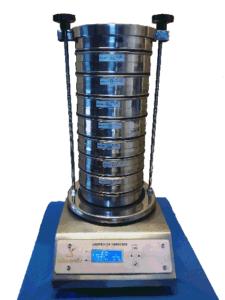
Granulometric testing can be defined as the gradual measurement or calibration of the particles that form soils and sedimentary formations or particles, in order to analyze both their origin and their mechanical properties.
It consists of passing the particles through a column of sieves of different mesh sizes. It is important that the sieves used comply with some of the international standards (ISO, UNE, ASTM, etc.) and are not broken or clogged, so that the data obtained can be reliable.
The sieves should be arranged in the form of a column one above the other, from the largest to the smallest mesh opening and placed on a laboratory electromagnetic sieve shaker, not forgetting to place a product collection bottom at the base of the column.
Sieve the product for about 5 to 10 minutes. Depending on the particle size or mesh spacing the required sieving time may be longer.
If a sieve shaker is not available, the test can be carried out manually, using one more sieve and a collection bottom, starting with the most open slot and transferring the particles that have passed to the next sieve.
Once the sieving process is finished, we must proceed to weigh the material retained in each of the sieves, the sum of all the weights must coincide with the weight of the initial material. Taking this weight as 100 %, we calculate the percentages of the weights obtained in each of the sieves and the collection fund used. With these data we obtain a granulometric curve that will allow us to visualize the homogeneous or heterogeneous tendency of the particle grain sizes.