At sieves.es estamos de estreno. Nos complace presentar nuestra nueva página web, completamente renovada para ofrecer una experiencia de navegación más rápida, intuitiva y adaptada a las necesidades de nuestros clientes.
Además del nuevo diseño, estrenamos también imagen corporativa con un logo actualizado que refleja la evolución de nuestra empresa y nuestro compromiso con la calidad y el servicio.
Hemos rediseñado nuestra web pensando en que encontrar el tamiz o accesorio que necesitas sea más sencillo que nunca. La nueva estructura permite acceder de forma rápida a nuestros productos, consultar sus características y realizar pedidos de una manera cómoda y segura.
Uno de los grandes avances de esta nueva versión es la incorporación de la compra online en diferentes idiomas, facilitando el proceso de compra a nuestros clientes internacionales.
Actualmente realizamos envíos desde España a:
De esta forma, seguimos ampliando nuestra presencia en Europa y ofreciendo un servicio más cercano y accesible a empresas y profesionales de distintos países.
Esta renovación es un paso más en nuestro compromiso por mejorar continuamente. Queremos que nuestros clientes disfruten de una plataforma moderna, eficiente y preparada para responder a sus necesidades, manteniendo siempre la calidad de nuestros productos y la atención personalizada que nos caracteriza.
Te invitamos a descubrir todas las novedades visitando sieves.es y esperamos que esta nueva etapa te permita encontrar todo lo que necesitas de una forma aún más cómoda y rápida.
¡Bienvenido a la nueva sieves.es!
 |
 |
|
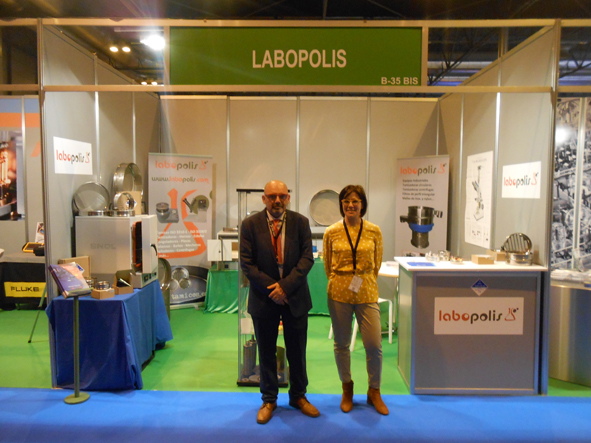
At LABOPOLIS SL we are pleased invite you to the IX edition of Farmaforum (Pharmaceutical Industry Forum, Biopharmaceutical Industry and Laboratory Technologies), which will take place on September next September 20 and 21 in pavilion 14 at IFEMA (Madrid). Visit us at our booth D-35. |
Once again, we are pleased to inform you that we will be present on October 5 and 6, 2022, at the new edition of Farmaforum 2022, which will take place in Pavilion 14.
We will be waiting for you at the STAND G-34.
If you wish to receive an invitation, please fill out our contact form or send us an e-mail with your contact information to info@labopolis.com, and we will send it to you as soon as possible.

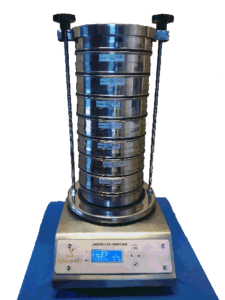
Labopolis is pleased to present its new digital electromagnetic laboratory sieve shaker, which complements our laboratory sieves.
If you need to make your sieving process more agile and reliable, you need to do it through the 20CT-200 electromagnetic sieving machine.
Its housing is made of polished AISI-304 stainless steel.It is very robust and suitable for food use.
The sieve shaker allows you to use 200mm or 203mm sieves, in continuous or intermittent mode.
It has an easy-to-use backlit digital control panel.
It allows the selection of Manual or PROGRAM mode, with 9 programs available so that you can save the parameters used, in order to guarantee the repeatability and reproducibility of the process.
Dry or wet sieving can be carried out by acquiring the necessary accessories.

In issue 99 of Farmespaña Industrial magazine, we published an article to explain many of the doubts you ask us in your queries about sieving processes, the determination of the useful life of a sieve, how to select the right sieve shaker for our processes, etc.
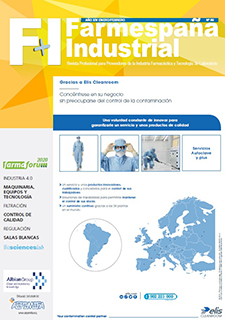
You can also download the article in pdf directly:
Artículo Labopolis en Farmespaña
We hope you find it useful
New change of dates for Farmaforum, this time we go to the year 2021, it will be on November 3 - 4, 2021, LABOPOLIS will be exhibiting at Farmaforum at IFEMA Madrid.
The Pavilion has been changed to No. 7
We will be waiting for you at the STAND A-26.
If you would like to receive an invitation, please fill out our contact form with your information and we will send it to you when available.
The Labopolis team thanks you for visiting our booth during Farmaforum 2019, and invites you to visit us next year at Farmaforum 2020 (April 15-16).
Son muchas las dudas y preguntas que nos hacen sobre este tema, ¿qué norma debo utilizar ISO o ASTM?, ¿los tamices son iguales con una u otra norma?.
The ISO standard is the denomination of the European standard and the ASTM the denomination of the American standard, the sieves manufactured with one or the other standard are the same, the only difference is that the European standard ISO 3310/1, for wire mesh sieves, or ISO 3310/2, for square or round perforated plate sieves, contemplates many more positions of openings than ASTM E11, for mesh sieves, or ASTM E323, for plate sieves, and there is a table of equivalences to be able to request sieves of one or the other standard.
Each sieve we manufacture is marked with a unique serial number that identifies it, and includes the manufacturing certificate in accordance with the chosen ISO or ASTM standard.
When placing your order you can select that standard, and the sieves will be delivered marked and certified with the selected standard, as you will see, some of the sieves are only in ISO standard, because there is no equivalent in ASTM, and others can be selected in any of the two.
In the following link you can download the table with the ISO 3310/1, ISO 3310/2, ASTM E11 and ASTM E323 standards, with all the mesh or plate spans covered by the standards and their corresponding equivalences:
Comparison table of sieves ISO - ASTM standards
Granulometric testing can be defined as the gradual measurement or calibration of the particles that form soils and sedimentary formations or particles, in order to analyze both their origin and their mechanical properties.
It consists of passing the particles through a column of sieves of different mesh sizes. It is important that the sieves used comply with some of the international standards (ISO, UNE, ASTM, etc.) and are not broken or clogged, so that the data obtained can be reliable.
The sieves should be arranged in the form of a column one above the other, from the largest to the smallest mesh opening and placed on a laboratory electromagnetic sieve shaker, not forgetting to place a product collection bottom at the base of the column.
Sieve the product for about 5 to 10 minutes. Depending on the particle size or mesh spacing the required sieving time may be longer.
If a sieve shaker is not available, the test can be carried out manually, using one more sieve and a collection bottom, starting with the most open slot and transferring the particles that have passed to the next sieve.
Once the sieving process is finished, we must proceed to weigh the material retained in each of the sieves, the sum of all the weights must coincide with the weight of the initial material. Taking this weight as 100 %, we calculate the percentages of the weights obtained in each of the sieves and the collection fund used. With these data we obtain a granulometric curve that will allow us to visualize the homogeneous or heterogeneous tendency of the particle grain sizes.
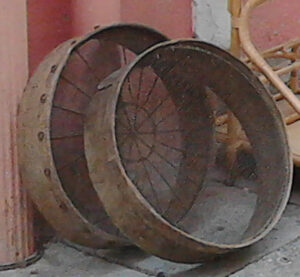
Cedazo, garbillo, tamiz, zaranda, criba o filtro. Son muchos los nombres que recibe esta herramienta, utilizada desde hace siglos para un mismo propósito: separar, clasificar y analizar materiales de diferentes tamaños.
Aunque hoy en día los tamices forman parte del equipamiento habitual de laboratorios, industrias y centros de investigación, su origen se remonta a tiempos muy antiguos. A lo largo de la historia se han fabricado con materiales tan diversos como madera de haya, cuero, pieles, esparto o tejidos vegetales. Con el paso del tiempo, estos materiales dieron paso a las mallas metálicas de alta precisión y, más recientemente, a materiales como el acero inoxidable, que ofrecen una mayor durabilidad, resistencia y exactitud.
Los primeros tamices artesanales estaban formados por dos aros de madera entre los que se tensaba una malla para retener las partículas de mayor tamaño. Hoy en día, aquellos modelos tradicionales se han convertido en piezas de colección o elementos decorativos, mientras que los tamices modernos cumplen exigentes normas de fabricación y precisión para garantizar resultados fiables en múltiples aplicaciones.
El uso de los tamices se ha extendido a prácticamente todos los ámbitos donde es necesario separar o clasificar materiales según su tamaño de partícula.
En la minería, permiten clasificar minerales, buscar oro o preparar muestras para su análisis. En arqueología, son indispensables para recuperar pequeños restos que podrían pasar desapercibidos durante una excavación.
En el sector agrícola y alimentario, continúan desempeñando un papel fundamental en el tamizado y clasificación de harinas, cereales, cacao, café, especias, semillas, arroz, frutos secos, sal y muchos otros productos, mejorando tanto la calidad como la uniformidad del producto final.
La industria farmacéutica, química y cosmética también utiliza tamices de precisión para controlar el tamaño de las partículas de materias primas y productos acabados, asegurando que cumplen las especificaciones de fabricación y los estándares de calidad.
Una de las aplicaciones más importantes en la actualidad es el análisis granulométrico, imprescindible para conocer la distribución del tamaño de las partículas de un material.
Mediante el uso de torres de tamices, laboratorios de ensayo, universidades y departamentos de control de calidad pueden obtener resultados precisos y reproducibles que permiten evaluar las características físicas de una muestra.
Estos ensayos son esenciales en sectores como:
En los estudios de suelos, por ejemplo, la determinación de la granulometría resulta clave para diseñar cimentaciones, carreteras, puentes y otras infraestructuras con todas las garantías de seguridad.
Aunque su funcionamiento básico apenas ha cambiado durante siglos, la tecnología aplicada a los tamices ha evolucionado de forma extraordinaria. Actualmente existen tamices fabricados conforme a normas internacionales como ISO 3310 y ASTM E11, disponibles en diferentes diámetros, materiales y aberturas de malla para adaptarse a cualquier tipo de ensayo.
Además, el uso de tamizadoras automáticas permite realizar análisis más rápidos, repetibles y precisos, optimizando el trabajo en laboratorios e industrias.
Desde los antiguos cedazos de madera hasta los modernos tamices de laboratorio fabricados con acero inoxidable de alta calidad, esta herramienta ha acompañado el desarrollo de numerosas actividades humanas.
Su capacidad para clasificar materiales con precisión sigue siendo imprescindible en sectores tan diversos como la investigación, la industria, la construcción, la alimentación o el control de calidad, demostrando que, pese al paso del tiempo, el tamiz continúa siendo una pieza fundamental para obtener resultados fiables.